Appeals and challenges are among the most time-consuming parts of any enforcement operation. In a recent Unity5 webinar, our team showed how a carefully designed AI assistant can take the strain out of the process, without taking the decision out of human hands.
For most parking teams, the appeals and challenges backlog is a familiar pressure point. It is often the most time-consuming part of the working day, and frequently the most complex. Statutory guidance has to be applied consistently, evidence has to be checked, and every response has to stand up to scrutiny. At the same time, teams are being asked to do more with less, and the answer is not always more resource. Sometimes it is simply being smarter with the tools already at hand.
That challenge has been sharpened by a newer trend. As several attendees observed during the webinar, a growing share of representations now arrive in long, formulaic, AI-generated form, often padded with points that have little to do with why the ticket was issued in the first place. For officers, that means more to read, more noise, and more time spent separating substance from waffle.
It was against this backdrop that Hannah Fuller, James Hampton and Rob Harvey introduced Unity5’s new AI-assisted approach to appeals and challenges: a capability first shown at Parkex 2026, and designed, in the team’s words, to move enforcement teams “from friction to flow.”
The officer is still in the chair
The principle underpinning the whole project is restraint. AI can sound as though it removes the human from the process, but Unity5’s position is the opposite. The goal is to augment a service rather than fully delegate it, to help teams handle higher volumes while the decisions that matter are still made by people.
That philosophy shaped the timeline as much as the product. As the team relayed, the brief from Unity5’s CTO was to get it right rather than get it out: do this well and it is better to be a little late than to dent anyone’s confidence. The result is a tool the team is comfortable describing, in plain terms, as “an evolution, not a revolution.”
Priming the model on your own rules
The first practical question was how to make a single AI assistant relevant to many different authorities and operators, when no two sets of rules are quite the same. The answer turned out to be something almost everyone already has: parking and cancellation policies.
By utilising an organisation’s own parking and cancellation policies, and, for private-sector operators, the relevant single code of practice and appeals charter, the assistant is “primed” with the rules its suggestions must follow. Teams can go further, adding granular prompts for specific scenarios, and can scope the tool to particular sites or clients. Crucially, the system is only ever as good as the policies it is given: without them, it would have nothing to reason against.

Unity5’s AI-powered chatbot conversation assistant for intelligent appeals responses saves time for parking managers and operators and their teams.
Three stages: details, reasoning, decision
When a challenge arrives, the assistant works through three stages.
- Key details. It reads the content of the challenge and any uploaded images, then surfaces the essentials, the contravention, where and when it occurred, who is challenging, the reason given and the evidence supplied. Officers no longer need to download and pore over every attachment to get the picture.
- Reasoning. It sets out the steps it took to reach a view, referencing the specific policy rules that apply, so the logic is transparent rather than a black box.
- Suggested decision. It returns one of three outcomes, approve, reject, or review where the references are ambiguous, each with a confidence rating. It is explicitly prompted to stay within the uploaded policies and not to guess or invent. Where it cannot reach a confident view, it hands the case to a person.
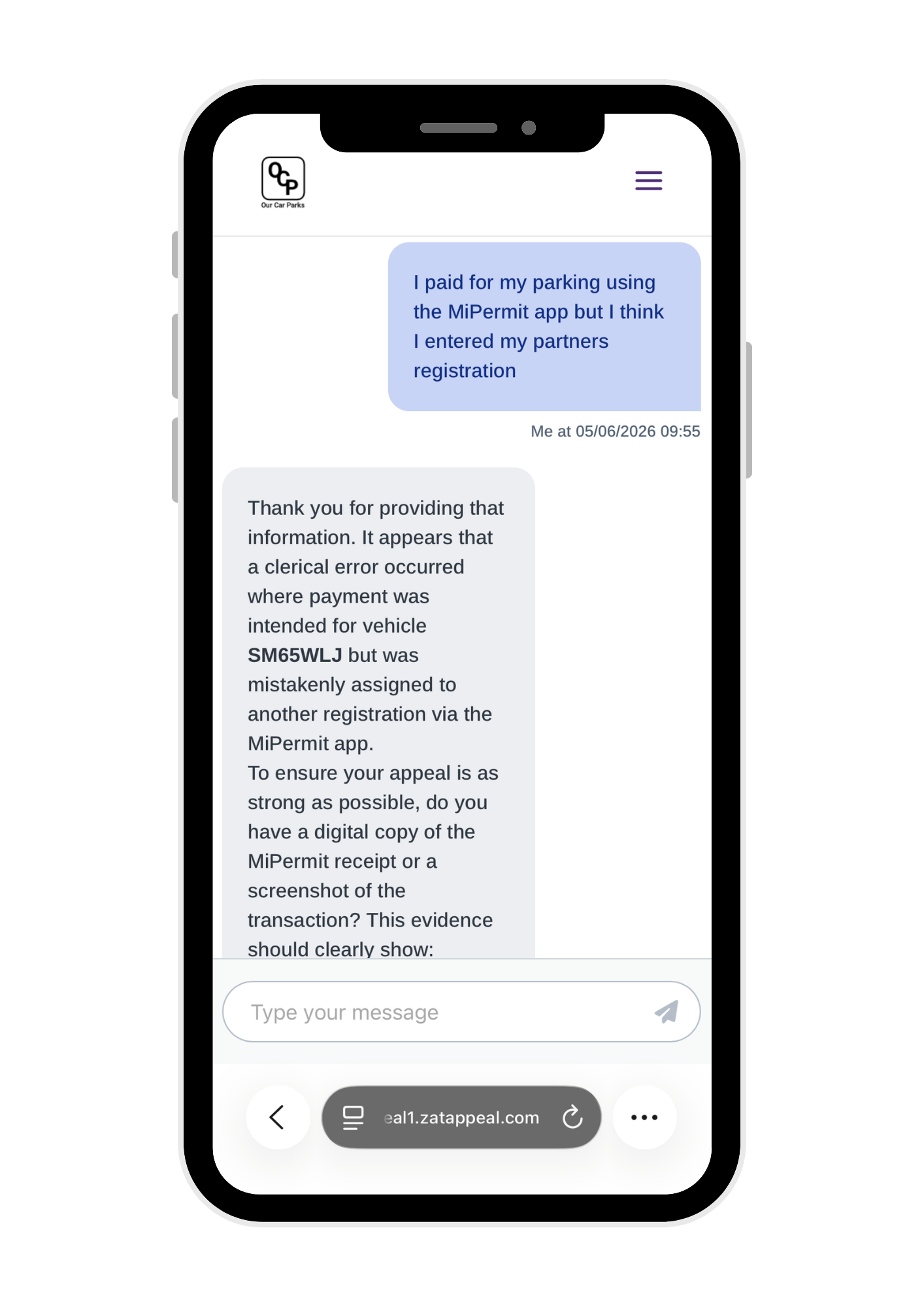
An example of Unity5’s chatbot in conversation with a motorist.
Surfacing what matters most
Alongside the decision, the tool flags the things teams most want to see early. It can highlight tone and sentiment, including aggressive or abusive language; it can surface signs of vulnerability, picking up references such as a Blue Badge, accessibility or assistance; and it can identify representations that appear to have been written by AI or copied from a template. All of this is presented up front, before anyone has opened the case, directly addressing the “lengthy, formulaic and uniform” submissions attendees said are becoming the norm.
From suggestion to response — in a few clicks
The assistant does not stop at a recommendation. Using pre-configured templates with merge fields, it can draft a motorist-friendly response built from the case details, the reasoning and the decision, primed, again, to stick to the facts and stay on topic. The officer reviews it, can override any suggestion, attaches the relevant evidence and submits. The team’s design goal was to resolve a straightforward challenge in five clicks or fewer.
The human-in-the-loop safeguards are deliberate. Low-confidence cases route to manual review, and where an officer knows the correct outcome for a scenario the tool was unsure about, that can be added to the cancellation policy so the system handles it confidently next time.
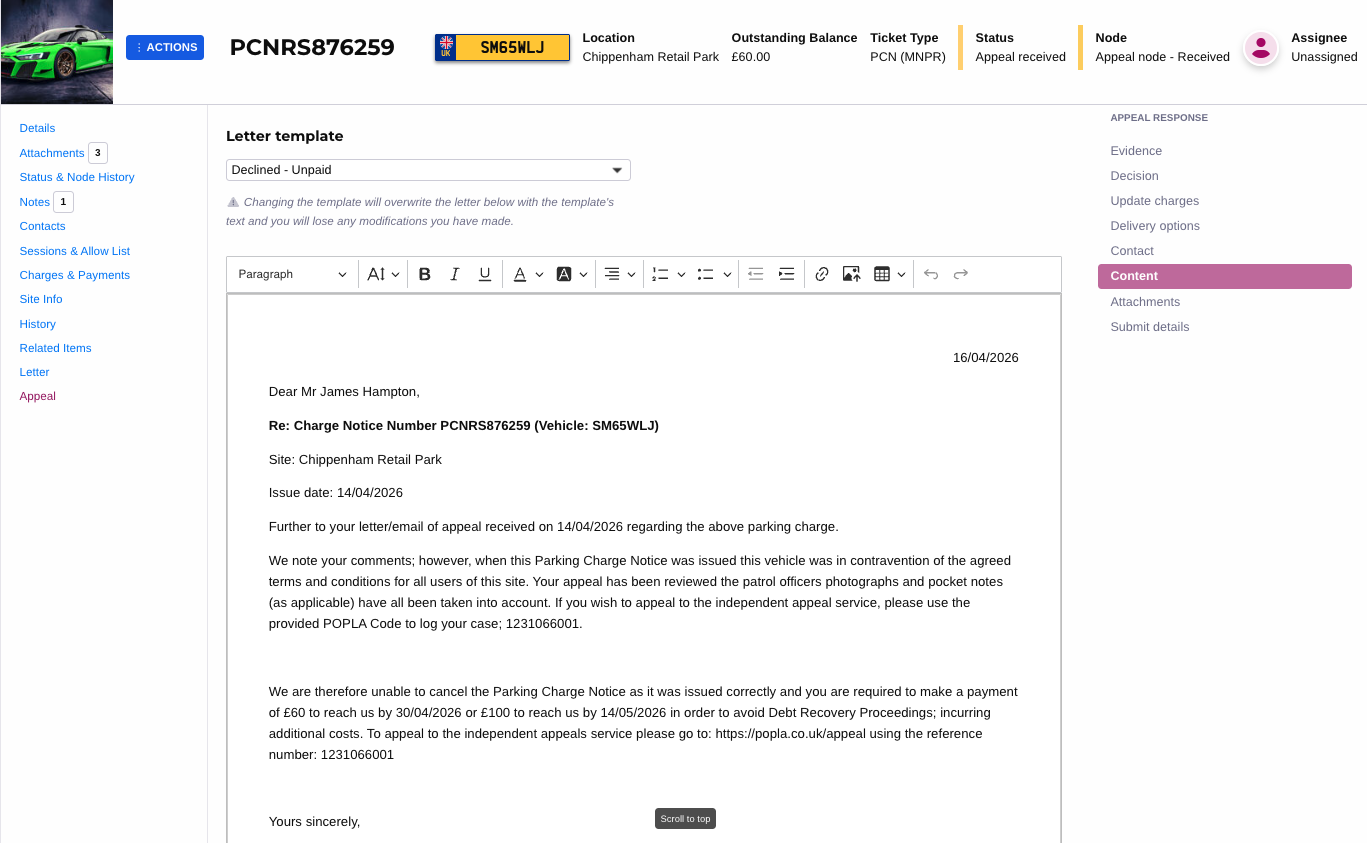
An example of Unity5’s motorist-friendly appeals response using AI
Honesty about the hard cases
Unity5 used the Blue Badge as a worked example precisely because it is an area of genuine contention, but the tool is far broader and applies to any representation. The team was candid about its limits. AI is good at spotting inconsistencies in an image, such as unusual edges or patterns, and can surface evidence that may have been falsified. But because AI is also good at creating convincing fakes, uncertain cases go to a human, and the roadmap includes a real-time look-up against the central Blue Badge service so that validation rests on the authoritative source rather than on AI inference alone. In a heavily legislated sector, the team was clear: someone still needs to put eyes on these cases.
Joining up the motorist experience
The appeals tool also connects to the customer-facing side. Unity5’s AI chatbot is designed to prompt motorists to provide strong evidence up front, while non-digital challenges can be scanned, uploaded and analysed using a manual trigger. Taken together, the aim is clearer guidance for motorists, fewer groundless challenges, and faster settlement where payment is genuinely due.
A day-one expert for your team
Perhaps the most useful way to think about the tool is the one the team offered themselves: it is like adding a new colleague who is fully up to speed on your policies from day one, without the time, cost and uncertainty of recruitment. The better the information it is given, and the more carefully it is monitored and trained, the better it performs.
That measured, accountable approach is characteristic of how Unity5 sees its role. Parking is part of the wider transport ecosystem, every car journey starts and ends with it, and our aim is to creator smarter ways to work in partnership with local authorities and operators to deliver standardised, fairer and faster outcomes for everyone involved.
Want to see how it performs against your own rules? Our team can prime the tool with your cancellation policies and show you how it handles your real challenges and appeals. Book a discovery call or get in touch to arrange a walkthrough.